Over Half of Website Traffic Isn’t Human. It’s Time to Rethink Performance Metrics.


Summary: Industry reporting shows that roughly 51% of website activity is driven by automated systems rather than people. As a result, how performance is formed and interpreted is shifting upstream, well before a visitor ever reaches a website. That shift has real implications for how you read your reports, defend budgets, and decide what to double down on.
Key Highlights:
- AI summaries are becoming the first touchpoint. Automated systems now scan and summarize your business before a prospect visits your site.
- Website traffic no longer tells the full visibility story. Content can influence awareness and credibility without showing up as a session.
- Search is shifting from exploration to conclusions. AI tools increasingly deliver direct answers, reshaping how discovery happens.
- Performance metrics don’t capture the full picture. Dashboards track visits and clicks, but miss how content is interpreted and reused elsewhere.
- Clarity determines whether you get surfaced correctly. In AI-mediated discovery, vague messaging makes businesses easier to overlook or misread.
- Strategy requires context, not reaction. Traffic declines don’t automatically mean relevance declines, and performance signals need interpretation before decisions are made.
More than half of the traffic hitting business websites isn’t coming from customers.
Imperva’s 2025 Bad Bot Report shows that roughly 51 percent of website activity is now driven by bots, not people. And these are not just the spam bots businesses have learned to ignore. A growing share comes from AI systems, search crawlers, and automated tools that scan, interpret, and reuse website content to power search results, generate answers, and train artificial intelligence platforms.
Cloudflare Radar 2025 Year in Review reporting reinforces the same pattern, with automated traffic accounting for a substantial share of global web activity. This is not a temporary spike. It reflects a structural shift in how the web operates.
At first glance, this can sound like a technical detail. Traffic is traffic, right?
But if every “visit” in your report is treated like a potential buyer, the data may be telling an incomplete story.
Numbers like this point to something more fundamental. How your business is being seen, evaluated, and discovered is changing, long before a buying decision is made.
That shift changes how you should interpret your performance results.
Why Bot Traffic Is Rising So Quickly
Bot activity has always existed. What has changed is the role these systems now play.
AI platforms and search engines like Google, along with large language models powering tools such as ChatGPT, Perplexity, and Gemini, are consuming far more website content as they generate answers, summaries, and recommendations. That demand has pushed automated systems to scan and revisit business websites at a scale most owners are only beginning to recognize.
Fewer users are clicking through multiple pages of Google search results. More are getting what they need directly from search summaries, featured snippets, or AI-powered tools.
As a result, automated systems increasingly determine which businesses get referenced, summarized, or surfaced before a customer ever visits a website.
In many cases, bots are now the first audience your content serves. Humans follow.
What may look like a traffic fluctuation is actually a change in how trust and visibility are formed during the buying process.
What the Data Is Telling Us About Website Activity
The takeaway is not just that bots exist. It is how much of today’s web activity they now represent.
Cloudflare’s global traffic analysis shows that AI bots alone account for a measurable share of total web requests. When you add traditional search engine crawling on top of that, a significant portion of activity hitting websites is not coming from people at all.
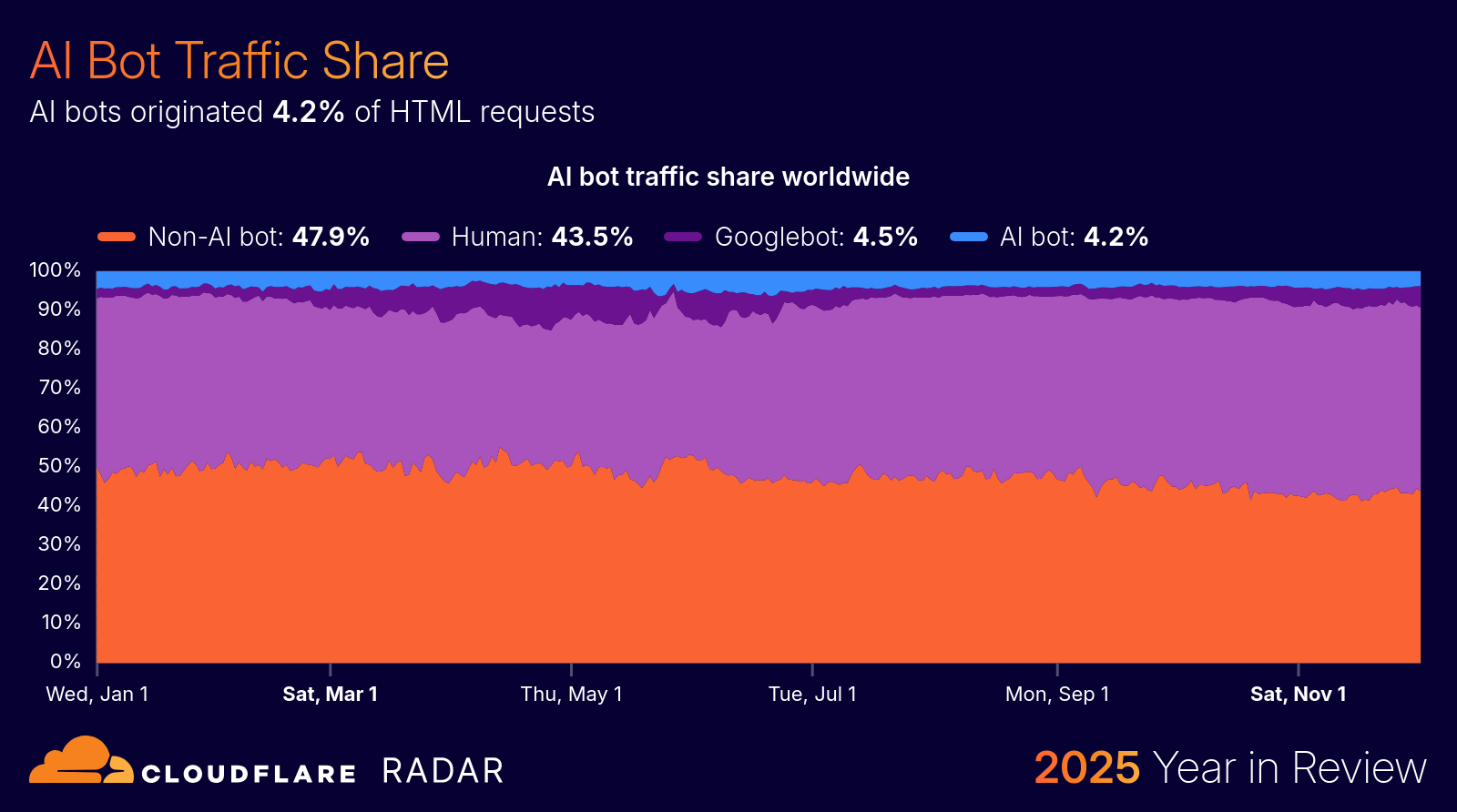
This reinforces what many businesses are already seeing in their analytics. Automated systems are constantly scanning and interpreting website content. Some help you appear in search results. Others support AI tools that summarize information directly for users. Either way, machines are evaluating your website before potential buyers ever reach out.
At the same time, search behavior continues to evolve. Multiple industry studies now show that a significant share of searches end without a click at all. Visibility still happens. It just doesn’t always register as a visit.
That means your content can shape perception and influence decisions without generating a website visit.
How This Changes the Way Website Performance Should Be Interpreted
For many businesses, website performance has long been judged by familiar signals: traffic volume, clicks, and conversions. When those numbers move, decisions follow.
But as automated systems account for a growing share of website activity, those signals become less straightforward. A drop in visits doesn’t always mean a drop in relevance. In some cases, your content is still being read or referenced, just not in ways that register as a traditional visit.
This creates a growing gap between what dashboards show and what’s actually happening behind the scenes.
For example, a leadership team may see flat or declining traffic and assume interest is fading. Budgets get paused. SEO gets questioned. Content plans get cut. Yet that same content may still be scanned, summarized, and referenced by search engines and AI tools shaping buyer perception before a conversation ever starts.
The signal didn’t disappear. It shifted upstream outside your standard dashboard.
A business owner sees sessions drop 18 percent and cuts content investment. Three months later, inbound sales conversations slow down. The visibility that was quietly shaping trust was turned off too early.
A Marketing Head is asked to justify spend. If their report only shows clicks and conversions, they can’t defend the visibility happening inside AI summaries or zero-click search results. The influence exists. The reporting doesn’t capture it.
How to Adjust Your Strategy Now
This doesn’t mean you need to overhaul your marketing. It does mean you need to interpret your numbers differently.
Here’s what that looks like.
1. Don’t panic over traffic dips.
If sessions drop slightly, it doesn’t automatically mean demand has fallen. Visibility may be happening elsewhere before a visit ever occurs.
2. Focus on outcomes, not just visits.
Are leads steady? Are sales conversations still happening? Is branded search holding? Those signals often matter more than raw traffic. If pipeline and revenue are steady, your visibility may be shifting, not shrinking.
3. Make it easier to understand what you do.
AI tools and search engines pull from clear messaging. If your services, industries, and value aren’t obvious, you increase the risk of being summarized incorrectly — or excluded entirely.
4. Stay consistent with long-term channels.
SEO and content influence buying decisions over time. Pulling back too quickly because dashboards fluctuate can stall momentum.
5. Ask better questions before cutting budget.
Instead of “Why is traffic down?” ask, “Is interest down, or is behavior changing?”
This isn’t about chasing every new AI trend. It’s about making smarter decisions with the data you already have.
Looking Ahead With Greater Clarity
Taken together, these changes redefine how visibility is formed and measured. As automated systems increasingly interpret and represent businesses on behalf of users, clarity of messaging and structure matter more than raw traffic volume. Surface-level metrics need context, and strategy now requires a broader view of how your business is discovered beyond traditional search results.
If your business is being interpreted before it is visited, your approach to SEO needs to reflect that reality. Adaptive Search Everywhere Optimization is built to help businesses strengthen how they are understood and surfaced across search and AI platforms. Start a Conversation About Search Strategy →
FAQs – Making Sense of Website Performance Signals
Why does bot traffic matter if it doesn’t convert?
Because bots increasingly shape how your business is evaluated and represented before a customer ever arrives on your website. Their influence affects visibility, credibility, and discovery upstream.
Does high bot traffic mean my website performance is weaker?
Not necessarily. A decline in visits does not automatically signal declining relevance if your content is still being scanned, summarized, and referenced by search and AI systems.
How are AI systems using website content?
AI systems scan and interpret content to generate summaries, answers, and recommendations across search engines and AI-powered tools. This often happens without producing a traditional website visit.
Why are clicks becoming a less reliable performance metric?
Because many users now get answers directly from search results or AI tools. Visibility and influence can occur without a click being recorded in analytics.
What metrics should businesses pay closer attention to now?
Beyond traffic, businesses should focus on clarity of messaging, consistency, search presence, and how well content communicates intent to both humans and machines.
How should leaders interpret performance reports differently?
Performance data now requires context. Decisions should account for how content is being evaluated and reused, not just what appears in dashboards.
What is the biggest strategic takeaway from this shift?
Clear, well-structured messaging matters more than raw traffic volume. As automated systems mediate discovery, how your business is understood becomes a competitive advantage.

How to Set an SEO Budget Around Revenue and Search Opportunity

Entering New Markets: Holly Construction Realigns Its Digital Strategy With WSI
