From Q1 Slump to Customer Growth: 3 Retention Strategies That Work


Summary: While customer engagement typically dips post-holiday, smart businesses use Q1 as a springboard for sustainable growth. In this guide, we’ll show you three proven Q1 customer retention strategies that keep your best buyers active, loyal, and spending. Learn how to use segmentation for post-holiday re-engagement, launch referral and loyalty programs that drive incremental revenue, and deliver proactive support that prevents churn before it starts.
Here’s What You’ll Learn:
- January slowdown isn’t inevitable: Strategic customer retention turns seasonal lulls into high-value growth periods.
- Segment customers by behavior: Analyze post-holiday data to target high-potential segments with personalized, timely re-engagement campaigns.
- Use loyalty and referral incentives: Double down on customers who already love you—rewards and referral bonuses increase repeat sales and word of mouth.
- Proactive support reduces churn: Early outreach to recent buyers and prompt issue resolution helps preserve hard-won holiday customers.
- Personalization drives conversion: Tailored content, offers, and timing based on customer history significantly outperform generic messaging.
- Re-engagement beats re-acquisition: It’s cheaper and more effective to re-activate past buyers than win cold leads—especially post-holiday.
The holidays bring a surge of activity—but what happens in January? While the Q1 slowdown is common, it doesn’t have to catch your business off guard. The quiet period that follows the holiday rush is one of the most strategic times to focus on customer retention. By planning now—while engagement is high—you can re-engage recent buyers, reduce churn, and turn a typically slow quarter into a springboard for growth.
Let’s look at three Q1 customer retention strategies you can use to hold their interest and keep them coming back.
Why Q1 Is Your Most Overlooked Revenue Opportunity
January hits hard—sales dip, customers go silent, and returns spike. But this seasonal slowdown isn’t just a cost of doing business—it’s a strategic window to build long-term customer value. The weeks after the holidays are prime time to reconnect with recent buyers, double down on loyalty, and outmaneuver competitors who go quiet. At a time like this, exceptional customer experience becomes your growth engine—and your biggest edge.
The Post-Holiday Drop-Off (and What Causes It)
With the end of the holidays and the start of the New Year, there is an instant shift in the market. Urgency fades, budgets tighten, and shopping fatigue kicks in. People aren’t browsing for deals—they’re recovering from December.
The urgency that drove holiday sales now drops away, and your inventory moves slowly, if at all. Add to that the increase in returns and exchanges and the sudden irrelevance of many of the products that were selling like proverbial hot cakes just a month previously, and you have a recipe for rather sluggish turnover for at least the next three months.
But here’s the upside: this isn’t unexpected. That means you can plan for it. Businesses that treat Q1 as a retention and reactivation season—not a recovery period—see stronger year-round performance.
Why Re-Engagement is Your Q1 ROI Advantage
Getting a customer back is almost always cheaper—and more effective—than finding a new one. While re-acquisition can mean cold outreach, ads, and fresh data collection, re-engagement taps into what you already know: buyer history, preferences, and timing. The math is clear: selling to an existing customer has a 60–70% success rate, while new prospects convert at just 5–20%.
For growth-minded businesses, Q1 is your window to act early—before holiday buyers go cold. Re-engaging now costs less, converts faster, and strengthens the customer lifetime value you already invested in.
Considering the value of re-engagement at this crucial time of year, let’s take a look at three re-engagement strategies you can use to keep your customers coming back during Q1.
Strategy #1: Use Segmentation to Drive Post-Holiday Conversions
One of the most effective tools in your re-engagement and retention kit is customer data. More specifically, data you can use to segment your audience and personalize your messaging for each group or individual.
The fastest path to retention in Q1? Treat different customers differently. When you segment your holiday buyers based on behavior and preferences, you can send timely, relevant offers that feel personal—and convert.
Personalization is not just an added extra. It’s a marketing essential. Between 60% and 70% of customers expect companies to understand their individual needs or receive a personalized experience.
There are several ways to segment your audience, and you may want to employ some or all of them, depending on your goals. They include:
- First-time vs. repeat buyers: Welcome new customers with a curated intro offer; reward loyal ones with early access or loyalty perks.
- Product categories: Align follow-up messages with what they browsed or bought.
- Gift buyers vs. self-buyers: People who bought gifts in December may not need more of the same, but they might be open to “something for you” campaigns in January.
- Cart Abandoners: Automate reminders with urgency or time-limited incentives.
- Sales values: Separate high-value buyers from low-value, once-off purchases. High-value customers are excellent candidates for loyalty programs or exclusive perks.
- Use Smart Tools to Automate the Work: CRMs like HubSpot, VBOUT, or SharpSpring can automate behavior-triggered flows. Use purchase history to recommend relevant products, set up reactivation campaigns, or push limited-time bundles.
Turn Purchase History into Revenue Triggers
Your holiday sales data is a retention goldmine—if you use it smartly. By analyzing past purchases, you can create campaigns that feel personal and perfectly timed.
Your CMS can be automated to perform this sorting based on data gathered from various purchase histories. Systems such as HubSpot, SharSpring, VBOUT, and others all offer this functionality.
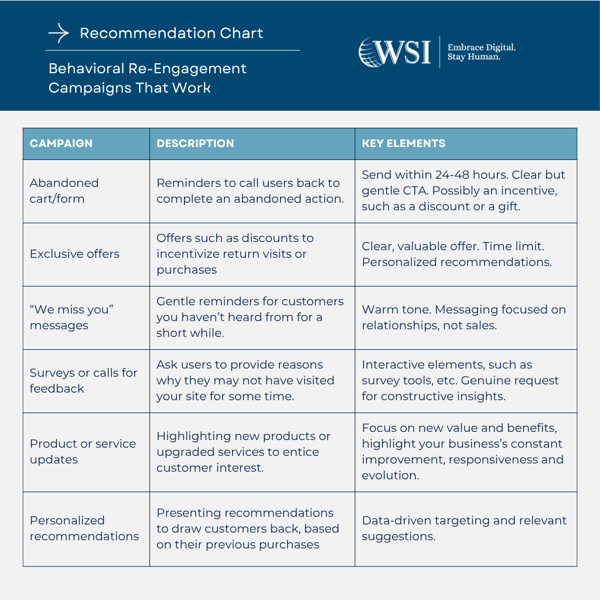
Behavioral Re-Engagement Campaigns That Work
Having segmented your audience, you can trigger specific communications to each segment at the appropriate times. Campaigns could include the following:
Use AI to Flag Churn Before it Happens
Don’t wait for customers to go silent—predict churn before it costs you. AI tools can analyze support history, product usage, and sentiment to spot risk and trigger timely interventions. Some of the most popular include:
- Zendesk: Uses AI to power customer experience software that analyzes support interactions for sentiment, flags at-risk customers, and automates intelligent case routing for quick resolution.
- Gainsight: A customer success platform that uses machine learning to generate customer “health scores” by integrating data from product usage, support, and surveys, allowing teams to prioritize at-risk accounts.
- ChurnZero: A customer success platform that provides a “churn score” based on product usage, support history, and renewal data. It enables automated communication and personalized onboarding for effective intervention.
- Pecan: An automated platform for building and deploying predictive churn models, making advanced analytics accessible to business teams without a data science background.
These tools give your team a proactive edge: reach out before customers leave, personalize support at scale, and turn Q1 into a loyalty-building opportunity.
Strategy #2: Build Loyalty and Multiply Word-of-Mouth
Your best customers are your biggest growth lever in Q1. Loyalty and referral programs don’t just retain—they amplify. Members spend more, refer more, and stay longer. In fact, loyalty programs generate 12-18% more incremental revenue per year than non-members. That is a conservative figure. Some studies suggest that the percentage is even higher.
Loyalty Programs That Go Beyond Discounts
Effective customer loyalty programs do more than offer discounts or free stuff: they make customers feel seen, valued, and connected to your brand. Use your loyalty programs to build communities, to deepen your customers’ love for your brand, and to create opportunities for social impact.
Consider perks like:
- Exclusive access to special offers or early access to new products.
- VIP-only experiences and privileges.
- Experiential rewards such as workshops, events, or personalized consultations.
- Community building and recognition
- Surprise-and-delight gestures, such as sending birthday gifts or celebrating membership anniversaries.
- Values-based initiatives, like opportunities to contribute to charitable causes or sustainability campaigns.
Referral Programs that Drive Scalable Growth
Loyalty programs often go no further than rewarding the customers you already have (not that there’s anything wrong with that, of course). But why stop there, though? Go one step further and create a referral structure that can attract new customers through word of mouth:
- Gamify referrals with tiered rewards or contests.
- Use shareable links and trackable codes to minimize friction.
- Leverage user-generated content by running contests or promotions that encourage customers to share videos, reviews, or any content related to your products.
Customers trust each other more than your ads. A strong referral offer turns loyalty into visibility—and into new business.
Strategy #3: Use Proactive Customer Service to Protect Hard-Won Customers
Great service isn’t just reactive—it’s strategic. Q1 is the perfect time to follow up, check in, and show customers you’re still invested. Done right, proactive support deepens loyalty and reduces churn with minimal cost. And with a few simple tactics, you can show customers you are a cut above the rest and really value them. That will invariably translate into loyalty and repeat visits.
Follow-Ups That Add Value
Follow-up messages can be effective when targeted, relevant, and timely. Your follow-up emails should provide new and useful information in each interaction, adding value rather than noise. Content strategies include:
- Share care tips, how-tos, or setup guides post-purchase.
- Send personalized “how’s it going?” check-ins.
- Offer surprise loyalty points or referral invites.
The message? “You matter—even after the sale.” And that’s what drives repeat business.
Surveys That Show You’re Listening
What’s the best way to show customers that you care what they think? Ask them what they think. Surveys serve a practical purpose in that they can provide you with great ideas to improve your products and services, but they also serve another, equally important function: providing an opportunity for customer interaction, giving your customers a voice, and making them feel like their opinions matter.
Keep it short (1-2 questions max) and close the loop by acting on the insights and letting customers know (especially so if you act on their feedback).
Make Automation Feel Human
Marketing automation is a valuable tool for customer support, but it’s important not to lose the human element. Aside from always having real humans available to interact with your customers when needed, you can also maintain the human element by making your chatbots and automated support systems as human as possible.
- Train your AI to detect human emotions and respond to them as quickly as possible.
- Ensure a seamless handoff to a human agent if it becomes necessary.
- Use conversational, brand-aligned language.
- Be mindful of what AI support can and can’t do.
Save high-level, high-value interactions for real humans and keep the routine stuff to AI. Exceeding AI’s limits is likely to have adverse effects on your customers’ experience.
What to Track: Metrics That Reveal Retention ROI
Don’t just launch campaigns—measure them. These key metrics will show whether your Q1 retention strategy is moving the needle
- Repeat Purchase Rate
- Formula: (Repeat Customers / Total Customers) x 100
- Indicates how many customers are coming back. A rising rate means your retention efforts are landing
- Time Between Purchases
- Tracks the average days between orders. Reducing this number means you’re accelerating revenue growth.
- Net Promoter Score (NPS)
- A quick read on customer sentiment and likelihood to refer. High NPS = strong brand loyalty and word-of-mouth potential.
These aren’t just numbers—they’re early signals of growth. Track them monthly to catch trends and course-correct fast.
Know Who’s Worth Winning Back
Not every customer is worth reactivating. The key is knowing which ones have high return potential—and which are quietly draining your resources.
Re-engage When:
- A certain inactivity time limit has been reached. The exact time will depend on your business and industry.
- The customer has a high CLV.
- There is an obvious reason for the inactivity, which you can address.
- You have new, relevant offerings that are likely to entice customers to come back.
- Your data shows that the customer in question was highly active for a considerable period before becoming inactive.
Let Go When:
- The customer is consistently unprofitable, and the cost of retaining them exceeds their potential value.
- Your offerings no longer fit the customer.
- The customer explicitly opts out of any further engagement.
- The period of inactivity is excessively long.
- The customer makes too many demands without providing any revenue in return.
Focus your Q1 energy on the buyers who show promise. That’s where growth lives.
Retention Isn’t Just Smart—It’s Profitable
A 5% increase in customer retention can boost profits by 25% to 95%. Why? Because retained customers:
- Spend more over time
- Refer new business
- Cost less to serve and re-engage
Acquiring a new customer can cost up to 7x more than keeping one. In Q1, when acquisition costs are high and attention spans are low, retention becomes your most efficient growth lever.
The Hidden Cost of Churn
While retaining customers incurs a cost that ultimately pays off, losing a customer costs more and is more damaging than many business owners realize.
- Lost lifetime value: You don’t just lose a single sale; you lose all potential future purchases and thus, the entire CLV of that customer.
- Cost of new customer acquisition: It is significantly more expensive to find and convert a new customer than to retain an existing one. Considering what you will need to pay for broad marketing, advertising, and sales efforts, it could cost up to seven times as much to bring in that new customer.
- Negative publicity: One lost customer could go out and share their negative experiences, discouraging new customers from coming your way.
- Missed referrals: When customers walk out the door, so do any potential referrals they could have provided for you.
On the whole, losing a customer is costly, making it much more worthwhile to concentrate on retention as far as that remains feasible.
Turn Q1 Into a Competitive Advantage
Seasonal slowdowns aren’t inevitable—they’re strategic opportunities in disguise. With the right mix of data-driven personalization, loyalty incentives, and proactive customer service, you can make Q1 your most efficient growth quarter.
Ready to build a retention engine that drives repeat sales, strengthens brand loyalty, and grows your bottom line—year-round? Schedule your free Customer Retention Strategy Session with WSI’s digital experts and discover how to convert seasonal lulls into sustainable momentum.
| FAQs About Customer Retention and Engagement Q: Why do businesses experience a post-holiday slump in Q1? After the holiday rush, customers often shift their focus from spending to saving, which reduces demand. Many also experience “shopping fatigue.” This combination of lower motivation and tighter budgets naturally causes slower sales. However, with targeted retention strategies, brands can maintain engagement and steady revenue through Q1. Q: Is it really more effective to re-engage past customers than acquire new ones? Yes—existing customers convert at 60–70%, while new leads average just 5–20%. Re-engagement also costs far less, making it one of the most profitable moves you can make in Q1. Q: What are the best ways to keep customers engaged after the holidays? Focus on re-engagement through personalization, loyalty programs, and strong customer service. Segment your audience based on holiday purchase behavior, offer relevant post-holiday deals, and use personalized email campaigns to stay top-of-mind without overwhelming your customers. Q: How can AI help reduce customer churn in Q1? AI tools like Zendesk and Gainsight analyze customer behavior and sentiment to flag churn risk early. This lets your team take action before a customer leaves—boosting retention and CLV. Q: How can loyalty programs help during the Q1 slowdown? Loyalty programs motivate repeat purchases as new customer acquisition slows. They make customers feel valued and can increase annual revenue by 12–18%. Offering points, early access, or exclusive perks keeps engagement high even during quieter months. Q: What metrics should I track to measure retention success in Q1? Key retention metrics include Repeat Purchase Rate, Time Between Purchases, and Net Promoter Score (NPS). These help you identify how well your campaigns are sustaining engagement and whether your reactivation efforts are paying off. Q: How can small businesses prevent customer churn after the holidays? Small businesses can prevent churn by using simple, low-cost tactics like personalized follow-up emails, “We miss you” campaigns, and proactive customer service. Even small gestures—like asking for feedback or offering a loyalty bonus—can strengthen relationships and keep customers coming back. Q: When should I stop trying to re-engage a customer? If a customer has shown prolonged inactivity, low lifetime value, or has opted out of all contact, it’s often more strategic to let them go and focus on higher-potential segments. |
Customers Are Researching You on TikTok, Reddit & LinkedIn. Are You Visible Where It Matters?

The Rise of AI Agents: When AI Moves From Answering Questions to Execution