If You Collect Customer Data, California Privacy Law Already Affects You


Summary: California’s Consumer Privacy Act (CCPA) and the California Privacy Rights Act (CPRA) set strict requirements for how businesses collect, use, disclose, and manage personal information from California residents. Designed to strengthen consumer data rights and transparency, these laws affect everything from website forms and CRM systems to advertising and analytics platforms. Understanding their impact helps organizations stay compliant while maintaining operational efficiency and customer trust.
Key Highlights
- California privacy law applies nationwide. If you collect data from California residents, CCPA and CPRA may apply regardless of your business location.
- Your marketing systems are part of compliance. Website tracking, CRM platforms, advertising tools, and analytics systems must support disclosure, consent, and consumer rights workflows.
- Consumer rights are enforceable and time-bound. Businesses must respond to access, deletion, and opt-out requests or face penalties of up to $7,500 per intentional violation.
- Compliance affects operations, not just policy. Vendor agreements, campaign configuration, and data retention practices must align with evolving privacy standards.
- Privacy regulation is expanding beyond California. Applying consistent data standards across channels reduces complexity and prepares your business for future state-level laws.
Your website tracking, paid advertising, and CRM systems are already subject to California privacy law—even if your business isn’t based in California.
The California Consumer Privacy Act (CCPA), later expanded by the California Privacy Rights Act (CPRA), introduced strict requirements for businesses that collect personal data from California residents. Location doesn’t matter. If you process their data, the law likely applies.
These regulations require businesses to clearly disclose what data they collect, respond to verified consumer requests, and provide mechanisms for individuals to opt out of the sale or sharing of personal information.
California set the pace, but it won’t be the last. Similar legislation is emerging across other U.S. states, signaling a broader shift in how customer data must be managed to maintain compliance and long-term trust.
To understand what this means operationally, it helps to clarify what CCPA and CPRA actually require.
What Are CCPA and CPRA?
California’s consumer privacy framework centers on two laws: the California Consumer Privacy Act (CCPA) and the California Privacy Rights Act (CPRA).
The CCPA, effective in 2020, introduced strict rules for businesses collecting personal information from California residents. It requires companies to disclose what data they collect, explain how it’s used, and respond to consumer requests for access or deletion.
In 2023, the CPRA strengthened enforcement, added new consumer rights, and created the California Privacy Protection Agency (CPPA) to oversee compliance. It also introduced limits on how sensitive personal information can be used.
Together, these laws define how personal information must be collected, stored, shared, and retained when tied to California residents, including data captured through websites, advertising platforms, CRM systems, and analytics tools.
Key Consumer Privacy Rights Under CCPA and CPRA
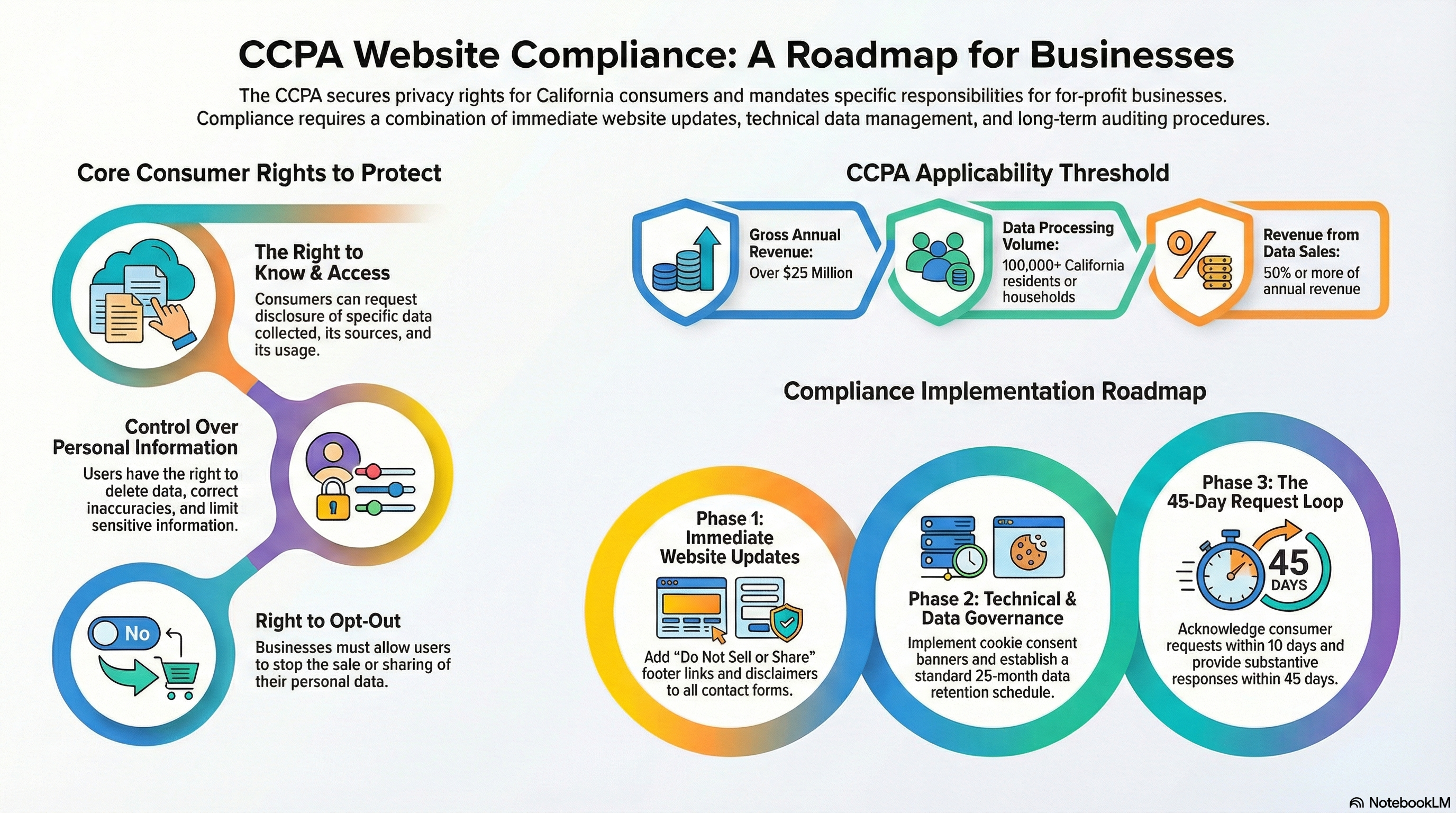
Consumers are granted specific rights regarding how their personal information is collected and used. These rights include the ability to:
- Know what personal data is collected and why
- Access the personal information a business holds about them
- Request deletion of personal information
- Opt out of the sale or sharing of personal information
- Correct inaccurate personal information
- Limit the use and disclosure of sensitive personal information
Businesses are required to respond to verified privacy requests within regulated timelines. Non-compliance may result in penalties of up to $7,500 per intentional violation. For businesses handling large volumes of data, exposure can escalate quickly.
Who Must Comply with CCPA and CPRA?
CCPA and CPRA apply to for-profit businesses that operate in California and meet at least one of the following thresholds:
- Annual gross revenues exceeding $25 million
- Buy, sell, or share the personal information of 100,000 or more California consumers, households, or devices in a year
- Derive 50 percent or more of annual revenue from selling or sharing California consumers’ personal information
The law also introduces additional protections for minors. Businesses must obtain affirmative authorization before selling or sharing the personal information of consumers under the age of 16. For children under 13, parental consent is required.
Consumers may also request details about how their personal information is shared with third parties, including the categories of data disclosed and the purposes behind that disclosure.
Quick Compliance Check
Before assuming you are covered, review the following areas across your organization:
Website and Forms: Do your contact forms, downloads, and checkout pages clearly disclose how personal data is collected, used, and shared?
CRM and Marketing Platforms: Can your systems identify, retrieve, correct, or delete personal data if a consumer submits a verified request?
Advertising and Analytics Tools: Do you understand what data is being shared with third-party ad networks, pixels, and tracking tools?
Vendor and Technology Contracts: Are your service providers contractually aligned with your privacy obligations and data handling standards?
Internal Governance: Is there a documented process and assigned responsibility for managing consumer privacy requests within required timelines?
If any of these areas lack clarity, your compliance risk may extend beyond policy documentation.
What If Your Business Isn’t Located in California?
CCPA and CPRA are triggered by your customers’ location, not your company’s headquarters.
If personal information is collected from California residents through your website, advertising campaigns, CRM systems, or analytics tools, these regulations may still apply. Businesses located outside California can still be subject to compliance requirements when handling data tied to California residents.
In practice, separating California consumer data from the rest of your database can quickly become operationally complex, especially when data flows across multiple platforms and vendors.
For this reason, many businesses choose to apply consistent privacy standards across all digital channels rather than manage compliance state by state. Aligning your data governance practices across channels simplifies compliance efforts and helps maintain trust as similar privacy regulations continue to emerge across other U.S. states.
What This Means for Your Organization
CCPA and CPRA directly affect how your marketing and operational systems handle customer data tied to California residents.
It Impacts More Than Policies
These requirements go far beyond a written privacy policy. They apply to information captured through website contact forms, newsletter signups, CRM systems, marketing automation platforms, advertising pixels, analytics tools, and third-party integrations. If these systems collect or process personal information, your business must provide proper disclosures and respond to verified consumer requests.
It Affects Operations, Not Just Legal Documentation
As enforcement continues to evolve and similar laws emerge across other states, privacy compliance is becoming an ongoing operational responsibility. It influences marketing processes, technology configurations, vendor agreements, and internal workflows. This isn’t a one-time update. It’s an ongoing governance issue.
Aligning Your Marketing Systems with Privacy Requirements
Privacy compliance now intersects directly with marketing performance. The same systems that drive lead generation and customer engagement must also support transparency, consent management, and responsible data handling.
Reviewing how data flows across your marketing stack helps identify risk, clarify vendor responsibilities, and ensure compliance does not disrupt campaign performance or reporting accuracy.
Organizations should consult qualified legal counsel to ensure full compliance with applicable regulations.
If you want clarity on how these requirements impact your website, analytics, CRM, or advertising tools, speak with a digital strategy advisor to review your setup and define practical next steps.
FAQs – What Businesses Should Know About CCPA and CPRA
What are CCPA and CPRA?
CCPA is the California Consumer Privacy Act, and CPRA is the California Privacy Rights Act, which expanded and strengthened CCPA. Together, they regulate how businesses collect, use, share, and retain personal information from California residents.
Does CCPA apply to businesses outside California?
Yes. If you collect personal information from California residents and meet the legal thresholds, the law can apply regardless of where your business is located.
Do small or mid-sized businesses need to worry about CPRA?
Possibly. If your revenue exceeds $25 million or you process data from 100,000 or more California consumers, households, or devices annually, compliance may be required.
Do marketing tools like CRM and analytics platforms fall under CCPA?
Yes. If these tools collect or process personal information tied to California residents, your business is responsible for disclosure and consumer rights management.
What are the penalties for non-compliance?
Penalties can reach up to $7,500 per intentional violation. For businesses handling high data volumes, exposure can escalate quickly.
What counts as “personal information” under CCPA?
Personal information includes identifiers such as names and email addresses, online activity, geolocation data, and other data that can be linked to an individual or household.
Is updating a privacy policy enough to comply?
No. Compliance requires operational processes, vendor alignment, consent mechanisms, and the ability to respond to verified consumer requests within required timelines.

Authority Is the New Currency in AI Search: 5 Signals That Establish Trust

How Much Should You Spend on Marketing? Aligning Your Budget With Growth Goals